


Wang Yi


Working across painting, installation, and material experimentation, his practice is grounded in what he defines as “Grand Geometry”, a framework where elementary structures operate as carriers of complex ideas. In this exhibition, that system shifts inward. Rather than constructing visible order, Wang Yi turns toward instability, atmosphere, and the conditions through which images emerge.
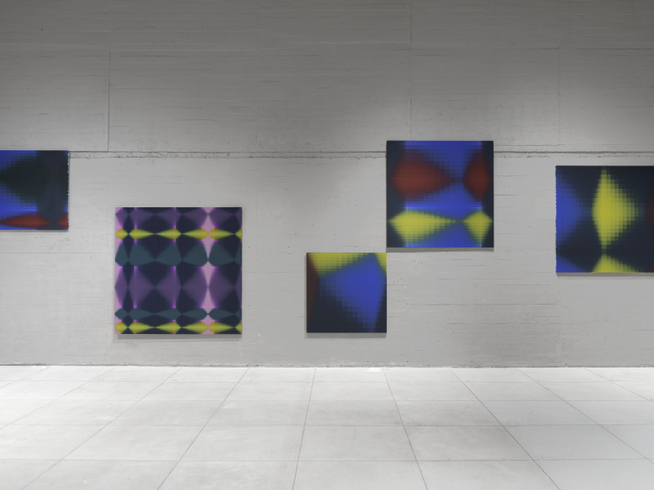
Penumbra and Shadow marks a body of work developed through processes of layering, diffusion, and gradual transformation. Built from hundreds of translucent applications of pigment, the surfaces resist immediacy. Forms do not appear fully defined; they unfold slowly, oscillating between presence and disappearance.
Drawing from Eastern philosophy and aesthetics, as well as Western painterly traditions, Wang Yi repositions shadow as an active condition rather than a lack of light. Inspired in part by Jun’ichirō Tanizaki’s In Praise of Shadows and Daoist thought, these works explore a space where perception is shaped by ambiguity, and where meaning is produced through duration.
In contrast to the speed and clarity of digital images, Wang Yi’s paintings require time. They invite a mode of looking that is attentive, mobile, and sustained. The image is never fixed. It shifts with light, distance, and the viewer’s position, constructing a field where perception becomes unstable and continuously negotiated.
In this sense, Penumbra and Shadow extends Wang Yi’s ongoing investigation of abstraction beyond form. It positions painting as a temporal experience, where structure dissolves into atmosphere, and where the act of seeing becomes a process of awareness.


